
What is big data?
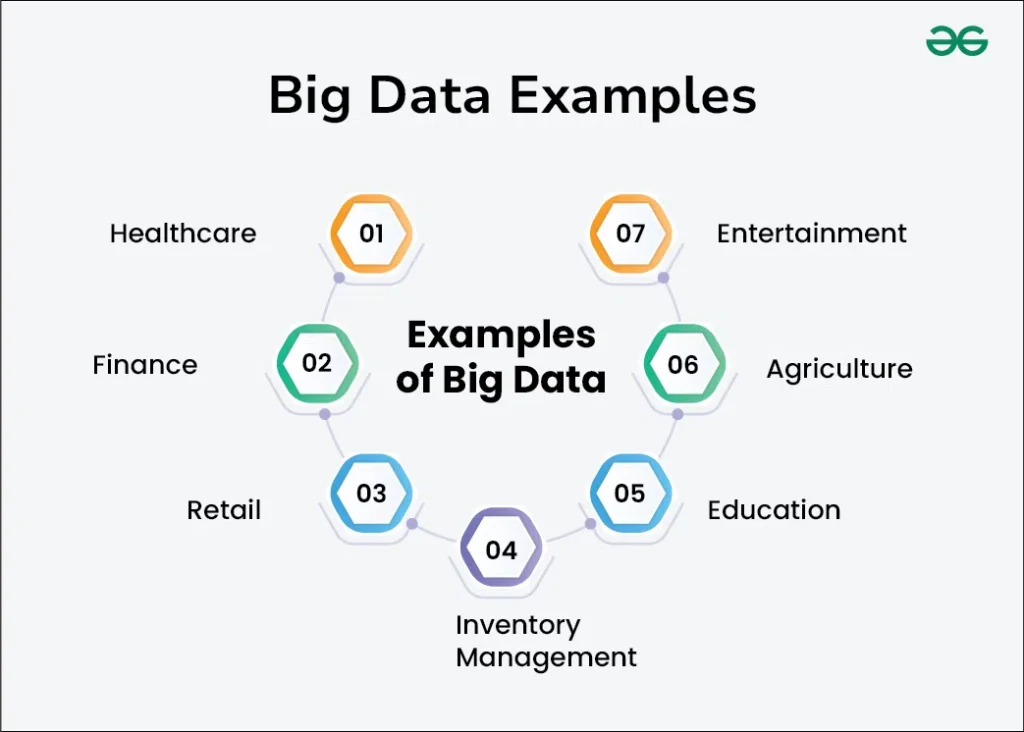
Big data is a combination of structured, semi-structured and unstructured data that organizations collect, analyze and mine for information and insights.
Big data refers to extremely large and complex data sets that cannot be easily managed or analyzed with traditional data processing tools
DEFINE : NOSQL
NoSQL stands for “Not Only SQL”.
NoSQL is a database that provides mechanism to store & retrieve data other than
relational database.
It is a class of DBMS that do not follow all of the rules of a RDBMS and cannot use
traditional SQL to query data.
It doesn’t required a fixed schema and have simple API
There are no needs to design a table to store data inside it.
NoSQL database is used for distributed data stores with huge data storage needs
NoSQL is used for Big data and real-time web apps.
what is structured, unstructured and semi structured data in mongodb?
Structured Data:
- Data with a predefined schema, like rows and columns in a table.
- Examples: Customer data (name, address, phone number), financial records, inventory details.
- MongoDB can store structured data, but its strength lies in its flexibility for other data types.
2. Semi-structured Data:
- Data with a flexible schema, often using tags or markers to organize information.
- Examples: JSON or XML documents, web logs, email messages.
- MongoDB excels at handling semi-structured data due to its document model.
- The document model allows for nested structures and varying fields within a document.
3. Unstructured Data:
- Data with no predefined format or schema, like text documents, images, audio, and video.
- Examples: Social media posts, sensor data, scanned documents.
- MongoDB can store unstructured data, often within its documents or by referencing external storage.
- Specialized tools and techniques may be needed to process and extract insights from unstructured data.
MongoDB’s Strengths:
- Flexibility: MongoDB’s document model and flexible schema allow it to adapt to changing data requirements.
- Scalability: MongoDB can handle large volumes of data and high traffic loads.
- Performance: MongoDB’s indexing capabilities and query language (MongoDB Query Language – MQL) allow for efficient data retrieval.
- Integration: MongoDB can integrate with various data sources and applications.
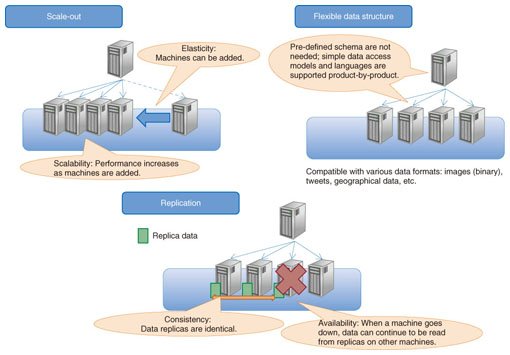
The three main features of NoSQL databases are
1. Scale-out: Scale-out refers to achieving high performance by using many machines in a distributed manner.
2. Replication: Replication is the copying of data to achieve data redundancy and load distribution.
3. Flexible data structure : A flexible data structure means that there is no need to define a structure as a database schema.
Topic:- History
Trailer:- (Only For Understanding)
(1) This question is about to understand that how NoSQL term started and what is the history?
Details:- (For Exam)
The term NoSQL was used by “Carlo Strozzi in 1998” to name his lightweight database.
It was NOSQL open source relational database that did not expose the standard SQL interface, but was still relational.
Most of the early NoSQL systems did not attempt to provide (ACID) atomicity, consistency, isolation and durability guarantees that will provided here.
Based on 2014 revenue, the NoSQL market leaders are MarkLogic, MongoDB, and Datastax.
Based on 2015 popularity rankings, the most popular NoSQL databases are MongoDB, Apache Cassandra, and Redis.
Topic:- Types of NoSQL databases
1. Key-value data stores:[Redis]
2.Document based data stores:- [mongodb]
3.Graph based data stores:-[Neo4j]
4.Column based data store:-[RDBMS]