🌱 Origins (Before Linux)
- In the 1970s, Unix was created at Bell Labs.
- Unix was powerful but commercial and closed-source, which limited free use in universities.
🚀 Birth of Linux (1991)
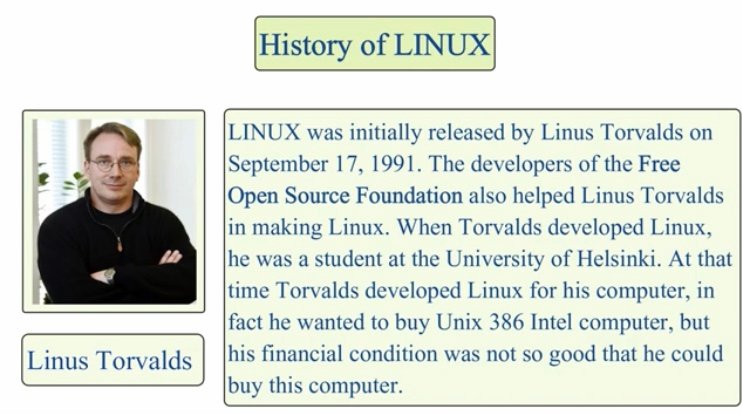
- In 1991, a Finnish student named Linus Torvalds started writing a free kernel as a hobby.
- On 25 August 1991, he announced Linux on a Usenet group.
- He released the source code under the GNU General Public License (GPL) so anyone could study, modify, and share it.
📌 Important:
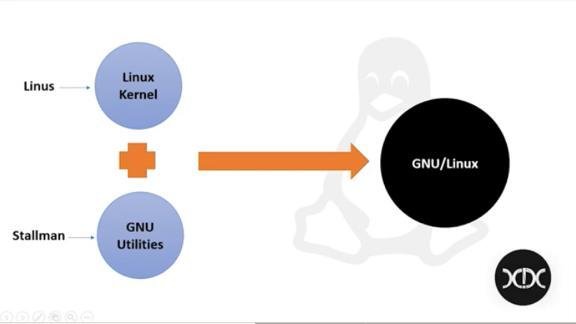
Linux = Kernel, not the complete operating system.
🧩 GNU + Linux = Complete OS
- The GNU Project already had essential tools (compiler, shell, utilities).
- Combining GNU tools + Linux kernel created a complete free operating system, commonly called GNU/Linux.
📦 Growth of Linux Distributions (1993–2000)
Different groups packaged the kernel with software → distributions (distros):
- Slackware (1993)
- Debian (1993)
- Red Hat (1994)
Each distro had its own installer, package manager, and focus.
🌍 Popularity & Adoption (2000–2010)
- Linux became dominant on:
- Servers
- Supercomputers
- Embedded systems
- Companies like IBM and Oracle began supporting Linux.
- Desktop environments like GNOME and KDE made Linux user-friendly.
📱 Modern Era (2010–Present)
- Android uses the Linux kernel → billions of devices.
- Linux powers:
- Cloud platforms (AWS, Azure, GCP)
- Containers (Docker, Kubernetes)
- IoT devices
- Today, Linux is one of the most widely used kernels in the world.